All guides · Guides
Tennis String Tension Loss Explained: Why Strings Go Dead
Tennis strings are plastic filaments, nylon or polyester mostly, pulled to tens of pounds and tied to a frame. Stretched plastic under constant load slowly gives up force whether or not anything touches it. So tension starts dropping the moment the clamp opens, falls fastest in the first hours, then keeps sliding at a slower and slower pace. Every ball you hit adds a little on top.
Key takeaway Tension loss is not a defect, it is what the material does. The biggest drop happens right after stringing, the rest is a long slow tail, and it continues in the bag. That is why "what percent of day one is left" tells you more than "what pounds did I string at".
What tension loss is
Tension loss is the drop in string tension after the racquet comes off the machine. Textbooks call it stress relaxation; players just say the strings went dead.
One thing to settle first. Pulling 55 on the machine does not mean the string bed is holding 55. Friction at the grommets eats some of the pull, a little slips each time a clamp moves, and the knots give back more. A bed measured straight off the machine reads below the machine setting, and that is normal. The machine number is the force applied; bed tension is the force that stayed.
Tension loss is what happens next: starting from what the bed actually held on day one, how much has drained away with time and play. So we look at now versus day one, not the machine number.
It starts the moment you're done stringing
Hang a rubber band on a door handle for a few months and it comes back longer. Plastic has the same habit: held stretched, it slowly creeps. A string tied into a frame cannot get longer, so instead it sheds pulling force. That is stress relaxation in plain words: the string gets used to its new length.
The shape matters more than any single number. When the clamp opens, the drop is a cliff. Between the stringing table and that evening, a large share of the total loss is already gone. By the next morning the slope has flattened, and from there the curve becomes a long tail sinking over weeks, slowly enough that you stop noticing day to day. Amounts vary with string and tension, but the first day often gives up as much as the following several weeks combined.
So a good chunk of tension loss is over before you reach the court. When a stringer says "play it tomorrow", they mean let the steepest part pass. Not many people listen.
Strings lose tension even if you don't play
Split tension loss into two buckets: what drains away while the racquet sits in the bag, and what drains away because you hit balls.
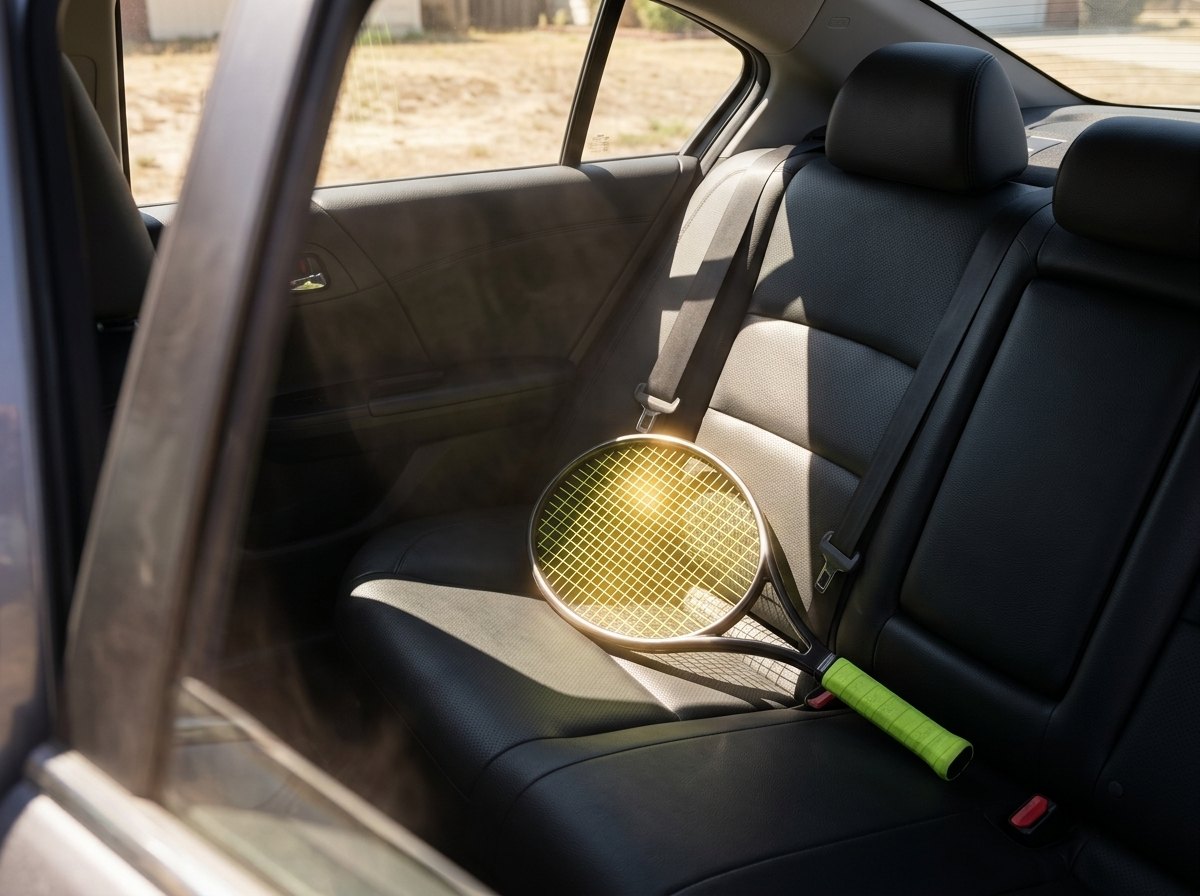
The sitting-in-the-bag share is the stress relaxation above, and temperature drives it hard. Warm plastic creeps more readily and sheds force faster. A racquet left in a car on a summer afternoon spends those hours in a tension loss accelerator. If you would not sit there, neither should the strings. Polyester is especially sensitive to heat; natural gut cares more about humidity than temperature.
The playing share works differently. Every impact stretches the strings a little further and lets them go. One hit costs almost nothing; a few thousand strokes add up to something you can measure. Hard hitters, frequent players, and heavy topspin players pay more here. "One month" means different things to a once-a-week player and a five-days-a-week player.
Why polyester loses tension faster
Three material groups: polyester (poly), bundled nylon (multifilament and synthetic gut), and natural gut.
Poly is stiff. It does not stretch much, and once it does, it does not spring back well. Low elasticity plus heavy stress relaxation means it gives up force quickly under a constant pull. Multifilament is many fine nylon strands twisted together, so it stretches and recovers, and tension loss is gentler. Natural gut is the most elastic of the three and holds tension well, with price and humidity as the catch.
Here is the poly paradox. Poly is tough, so it rarely breaks. But its tension drains fast and its surface hardens, so its usefulness runs out long before it snaps. A multifilament frays and breaks, which is its way of telling you the date. Poly looks fine and dies quietly. That is where "dead poly" came from.
Photo coming soon
Why dead poly feels 'trampoline' to some and 'like a board' to others
Both are right. Two things happen in the same bed at once.
First, as tension drops, the bed deflects deeper and rebounds like a trampoline. Balls launch higher and travel farther. The player who notices this says the strings feel "launchy". Flat hitters tend to feel it first.
Second, poly hardens over time. The crossing points notch, and the mains lose their ability to slide sideways and snap back. That snapback is where much of the spin comes from, so spin drops, the ball stops sitting on the strings, and impact turns dull and harsh. The player who notices this says the bed feels "like a board". Spin-heavy players tend to feel it first.
The first effect shows up in a tension measurement. The second barely does, which is why a bed can hold a fair amount of tension and still feel dead.
You have probably heard that dead poly is bad for your arm. Tennis elbow is shaped by many things at once: racquet weight and balance, technique, how much you play, your general condition. A hardened string bed may be one factor among those, and that is as far as anyone can honestly go.
What 'good tension maintenance' means
Tension maintenance, or retention, is how much of day-one tension a string still holds as time goes on. Not absolute pounds; the share of the start that was kept.
Some general tendencies. For the same material, a thicker gauge tends to hold tension better than a thinner one, because it stretches less under the same load. Construction matters too: multifilaments are usually gentler than solid polys, and among polys the recipe and process make a real difference. "All poly is the same" does not survive a measurement.
Our lab compares retention as a percent of day one: string at the same tension under the same conditions, re-measure over the following days, and see what fraction of the start remains. In September 2026 we published a three-string retention comparison at 50 lb on Instagram, plotted in percent rather than pounds, because percent reads the same regardless of string, racquet, or method.
What to actually watch
You need one reference point.
- Measure right after stringing. Not the machine number, but what the bed actually held that day. That is your baseline.
- Measure again. The next day, then about once a week, and your own curve appears.
- Read it as percent of day one. Absolute tension can be argued about; it depends on string, racquet, and method. The ratio between two measurements of the same racquet by the same method is a number nobody can argue with.
The RacquetPilot app does this with a phone. Tap the strings, the microphone reads the vibration frequency, and the app shows an estimated current tension and the percent of day one. No gadget, no recording, no account. Private beta on iPhone and Android for now.
Limits
- Tension loss describes part of a string's condition, not all of it. Notching and lost snapback barely register in a tension number, so a bed can hold tension and still feel like a board.
- Absolute tension is an estimate built on our own measurements, and we keep tightening it with more of them. What we stand behind is the change: the percent of day one.
- Temperature and humidity move the daily reading. That is the string actually changing, not measurement error, but compare under similar conditions.
- Our lab retention data covers three strings at one tension; it does not generalize to every string.
- "What percent means restring" differs from player to player. That question continues in the next article.
How much of day one is left in your strings?
Join the beta